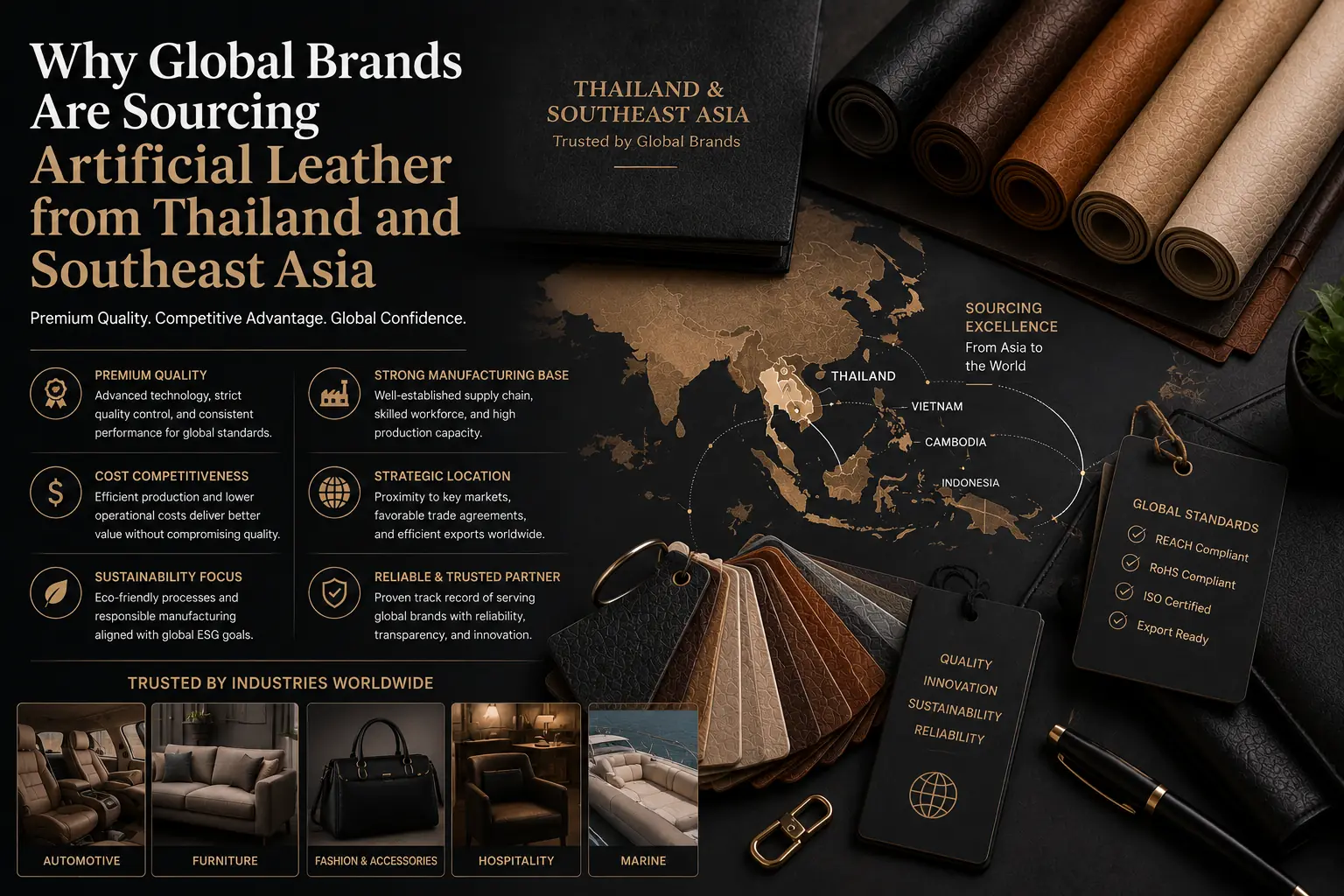
Global sourcing maps have been redrawn repeatedly over the past several years, and synthetic material supply chains are no exception. For buyers of artificial leather, PVC leather, and synthetic upholstery materials, Thailand and the wider ASEAN region have moved from a secondary sourcing option to a primary one for a growing number of furniture, automotive, and fashion brands. Here's what's driving the shift, and what buyers should know before sourcing from the region.
A Shorter Path Between Manufacturing Hubs
Thailand sits within close freight range of the manufacturing clusters most artificial leather ends up serving furniture factories in Vietnam and Indonesia, automotive assembly in Thailand itself, and fashion production across the region. For buyers who previously sourced synthetic leather from further afield and then shipped it back into ASEAN for cut-and-sew production, sourcing regionally removes an entire leg of the freight journey, along with the lead time and cost that comes with it.
Diversification Away From Single-Country Dependence
Many procurement teams have spent the past several years actively reducing reliance on any single sourcing country, for reasons ranging from freight cost volatility to geopolitical risk to simple resilience planning. Thailand's synthetic leather sector has benefited from this diversification, offering buyers an established, technically capable alternative rather than an unproven one.
Manufacturing Maturity, Not Just Low Cost
Thailand's synthetic leather sector isn't newly emerging it has served automotive and furniture export industries for years, which means the technical base is already in place: consistent coating processes, established testing capability, and manufacturers familiar with the documentation international buyers expect. This maturity is a meaningful difference from sourcing in a market where the synthetic leather industry is still developing its export-grade quality control.
Climate-Appropriate Material Engineering
Southeast Asia's manufacturing base has practical experience formulating synthetic and artificial leather for hot, humid conditions — a consideration that matters even for buyers whose end product will be used elsewhere, because materials engineered to resist heat and humidity during storage and transit tend to perform more consistently across a wider range of end-use climates too.
In-Stock Availability Changes the Sourcing Calculation
One of the more overlooked advantages of sourcing from an established regional hub is the prevalence of stocked, ready-to-ship inventory rather than made-to-order-only production. For buyers running smaller batch sizes, prototyping new product lines, or managing tight replenishment schedules, being able to draw from stock materially changes lead times compared with waiting on a full production run from a distant factory.
What to Check Before Committing to a Southeast Asian Supplier
- Confirm whether the supplier holds physical stock or is production-order only
- Check REACH or equivalent chemical compliance if you're re-exporting to the EU, UK, or North America
- Ask about freight forwarding relationships for FCL/LCL shipments if you don't have your own
- Request a sample pack before committing to any volume regional proximity doesn't eliminate the need for quality verification
A Regional Example
Bangkok in particular has developed into a notable hub for this category, with suppliers like Kodel Decorative operating stocked showrooms that serve both domestic Thai manufacturers and international buyers directly. As an artificial leather supplier in Thailand with an in-stock model and export-ready certification, this kind of operation reflects the broader shift buyers are responding to: a region that now offers manufacturing maturity alongside the freight and diversification advantages that first drew sourcing teams to look at ASEAN.
Final Word
The move toward Thailand and Southeast Asia for artificial and PVC leather sourcing isn't a short-term freight-cost trend — it reflects a region that has built the manufacturing depth to support it long-term. For buyers evaluating where to source next, the combination of proximity, documented compliance, and in-stock availability is worth weighing against a purely price-driven comparison.