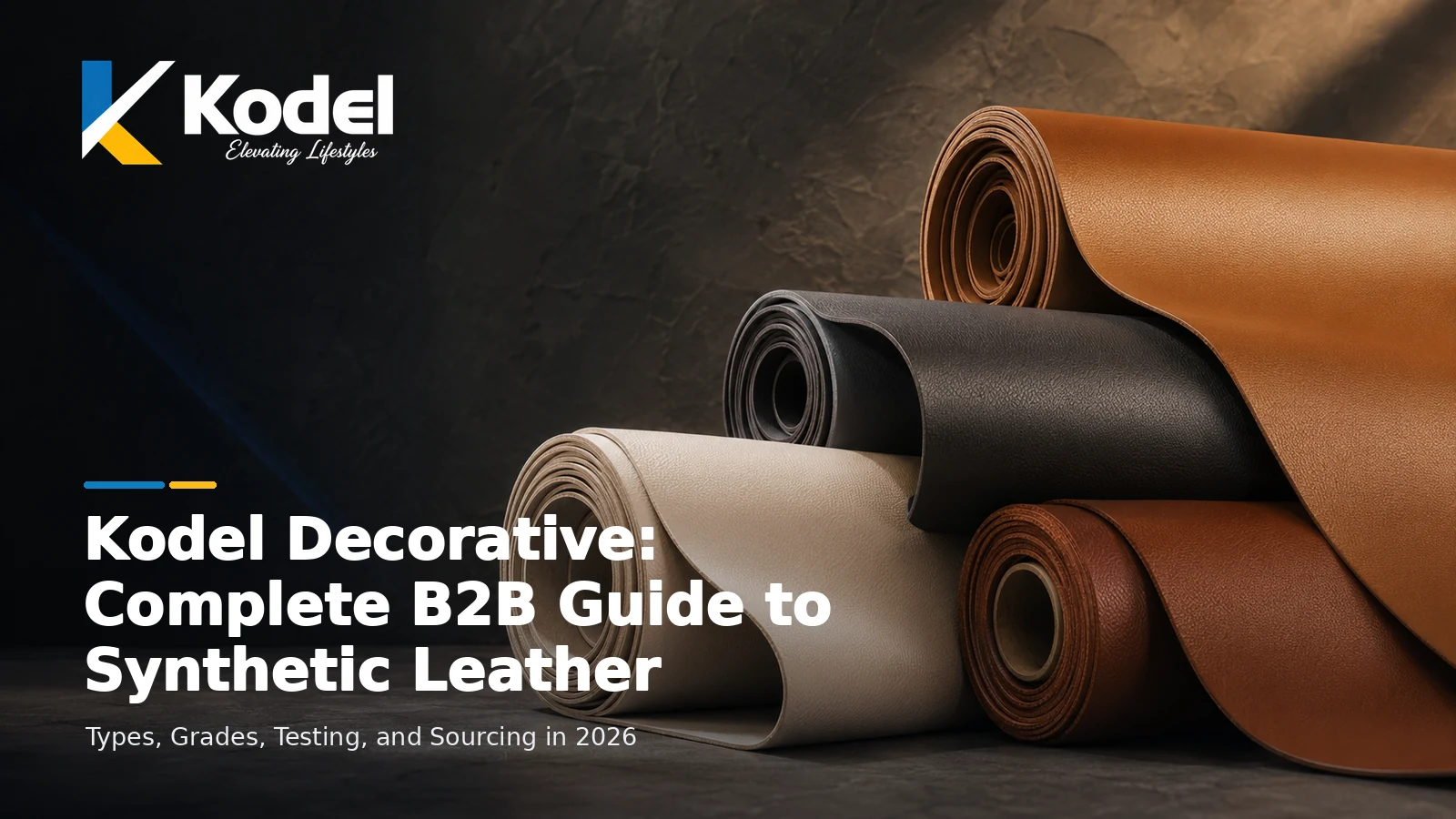
Global synthetic leather demand reached approximately 45 billion US dollars in 2024, according to Grand View Research, with the automotive and furniture sectors accounting for over 60 percent of volume procurement. India's synthetic leather manufacturing output grew at a compound annual rate of 9.2 percent from 2020 to 2024, driven by surging export orders from Southeast Asia, Europe, and the Middle East. Kodal Decorative supplies PU and PVC synthetic leather across these categories from its manufacturing and sourcing operations in India, serving B2B buyers ranging from furniture OEMs and automotive upholstery units to hospitality fit-out contractors and retail display manufacturers.
Synthetic leather is no longer a substitute category. It is a primary specification material for buyers who need consistent grain quality, colour fastness, fire-retardant compliance, and MOQ flexibility that genuine leather cannot reliably deliver at scale. This guide covers the complete procurement picture: material types and grades, application suitability, testing standards, pricing structures, sustainability credentials, and what to evaluate when selecting a supplier.
What Is Synthetic Leather and How Is It Made
Synthetic leather is an engineered textile product designed to replicate the appearance and functional properties of animal leather while offering superior consistency, controlled physical properties, and significantly lower price volatility. Two base chemistries dominate commercial supply: polyurethane (PU) and polyvinyl chloride (PVC). Each is manufactured on a textile or non-woven substrate, with the coating layer determining surface appearance, tactile feel, durability, and application suitability.
PU synthetic leather is produced by coating a knitted or woven fabric base with a polyurethane layer, which is then embossed with grain patterns using heated rollers. The result is a material that is softer, more breathable, and more supple than PVC. PU leather dominates premium furniture, fashion accessories, and light automotive interiors. PVC synthetic leather uses a heavier polyvinyl chloride coating on a woven or non-woven substrate, producing a harder-wearing surface with higher resistance to abrasion, chemicals, and UV degradation. PVC grades are the industry standard for heavy-duty seating, marine upholstery, and commercial hospitality applications.
A third category, thermoplastic polyurethane (TPU) leather, sits above both in performance and cost. TPU-coated materials offer exceptional tear resistance, operating temperature range, and flexibility retention at low temperatures. Automotive dashboards, steering wheel wraps, and medical equipment upholstery increasingly specify TPU grades. Kodal Decorative supplies all three base chemistries, with product selection guided by end-use performance requirements and target price point.
Key Types and Grades Available Through Kodal Decorative
Synthetic leather is not a single product. Buyers who specify 'synthetic leather' without grade and performance parameters will receive inconsistent quotes and may receive material unsuitable for their application. The table below maps the primary types available through Kodal Decorative to their performance characteristics and common end uses.
| Type | Chemistry | Thickness | Key Properties | Applications |
| Standard PU Leather | PU on knit | 0.6mm to 1.2mm | Soft hand, mid abrasion, wide colour range | Furniture upholstery, fashion accessories |
| Heavy-Duty PU Leather | High-density PU on woven | 1.0mm to 1.6mm | High abrasion, 50,000+ double rub | Commercial seating, automotive |
| Standard PVC Leather | PVC on non-woven | 0.8mm to 1.4mm | Chemical resistance, low cost | Hospitality, office chairs, retail display |
| Marine/Outdoor PVC | UV-stabilised PVC | 1.0mm to 2.0mm | UV, mould, moisture resistance | Outdoor furniture, marine upholstery |
| FR-Certified PU/PVC | Flame-retardant coating | 0.8mm to 1.4mm | Passes BS5852, MVSS302, Crib5 | Transport, hospitality, healthcare |
| Bio-Based PU Leather | Partially bio-content PU | 0.6mm to 1.2mm | Reduced fossil content, soft hand | Sustainable furniture, brand projects |
| TPU Leather | Thermoplastic polyurethane | 0.5mm to 1.0mm | High performance, wide temp range | Automotive, medical, accessories |
Buyers should always specify: thickness in millimetres, abrasion resistance target in Martindale or Wyzenbeek cycles, flame-retardant standard required if applicable, and colour reference (Pantone, RAL, or physical sample). Providing this information at the enquiry stage eliminates the single most common cause of delayed or inaccurate sampling.
Application Sectors and Material Matching
Furniture and Interior Upholstery
Furniture manufacturing accounts for the largest volume segment of synthetic leather procurement globally. Grand View Research's 2024 sector report attributes approximately 38 percent of synthetic leather consumption to residential and commercial furniture. For upholstery applications, buyers prioritise surface consistency across rolls, abrasion resistance above 30,000 Martindale cycles for contract use, and dimensional stability under stretched application conditions.
Kodal Decorative supplies furniture-grade PU leather in roll widths of 54 inches and 60 inches, with colour consistency guaranteed within Delta E 1.5 across a single order. For commercial hospitality clients requiring fire certification, FR-grade material meeting BS5852 Part 2 (Crib 5) is available on request with batch test certificates. Interior designers and furniture OEMs ordering above 500 metres per colour can access custom colour matching against physical reference samples with a seven-to-ten working day turnaround.
Automotive and Transport Upholstery
Automotive synthetic leather is a performance specification, not a style choice. Materials used in vehicle interiors must pass FMVSS 302 (US) or ECE R118 (Europe) flame resistance standards, resist UV fading across a minimum 200-hour Xenon arc test, and maintain flexibility at temperatures from minus 20 to plus 80 degrees Celsius. Abrasion resistance requirements for driver seats typically exceed 50,000 Wyzenbeek double rubs.
Kodal Decorative's automotive-grade PU and TPU materials are supplied with full third-party test documentation from accredited laboratories. Automotive buyers typically procure in widths of 54 inches with precise thickness tolerances of plus or minus 0.05mm, as die-cutting and stitching operations in assembly lines cannot accommodate variable-thickness stock. The company offers roll lengths of 30 metres and 50 metres to suit cutting room workflows.
Hospitality, Healthcare, and Institutional
Hospitals, hotels, restaurants, and educational institutions share a common procurement requirement: materials that are easy to clean, resistant to liquid penetration, durable under heavy daily use, and compliant with indoor environment standards. PVC-based synthetic leather with anti-microbial surface treatment is the standard specification for healthcare upholstery. The anti-microbial finish inhibits bacterial growth on the surface and is certified under ISO 22196, which is increasingly specified in NHS and private hospital procurement frameworks.
Hospitality buyers operating in the UK and EU frequently specify material meeting UKCA or CE indoor product regulations, along with fire certificates. Institutional procurement teams in India specify IS 15495 compliance for seating material in public buildings. Kodal Decorative can provide certification documentation for each applicable standard, and buyers should request the full compliance matrix at sampling stage rather than at order finalisation.
Retail Display, Packaging, and Fashion Accessories
Synthetic leather for retail display and fashion accessory manufacture operates on different performance criteria than upholstery. Surface aesthetics, emboss fidelity, and colour accuracy take priority over abrasion resistance. Buyers in this segment include handbag and footwear manufacturers, luxury retail fixture designers, and packaging studios producing high-end product boxes and portfolio covers.
Thin-gauge PU leather in the 0.5mm to 0.8mm range is the primary specification for fashion and packaging applications. Emboss options available through Kodal Decorative include full-grain, crocodile, ostrich, snake, linen, and plain matte, with the option to develop custom emboss tooling for minimum orders of 3,000 metres. Metallic and iridescent surface finishes are available in PU grades for luxury packaging applications.
Pricing Structure and MOQ Framework
Synthetic leather is priced per running metre, with the final price determined by material type, grade, thickness, surface finish, colour, FR certification, and order volume. Price volatility in synthetic leather is lower than genuine leather but tracks changes in crude oil derivatives (for PVC) and polyol and isocyanate feedstocks (for PU). In 2025, PU leather pricing in India ranged from approximately 85 to 320 Indian rupees per metre for standard grades, with FR-certified and performance grades priced 30 to 60 percent above standard.
Kodal Decorative operates a tiered MOQ structure. Standard in-stock colours have a minimum order of 100 metres per colour. Custom colour matches require a minimum of 300 metres per colour, and custom emboss tooling projects require a minimum of 3,000 metres per design. Sampling is available for rolls of two metres per colour, charged at a nominal rate that is credited against the first confirmed order. Payment terms for verified B2B accounts are 30 percent advance with balance against documents, with open account terms available for established accounts on application.
Buyers planning seasonal collections or project-based procurement should consider blanket order arrangements, where the full volume is committed upfront and delivered in scheduled call-offs. This structure locks in pricing, secures production slot priority, and reduces per-unit logistics cost. Kodal Decorative accommodates blanket orders with call-off windows of up to 12 months.
Testing, Certification, and Compliance
Procuring synthetic leather without verified test certification is one of the most frequent causes of material rejection, production line stoppages, and end-client disputes in the B2B supply chain. Buyers should request test reports for the following parameters as a baseline, regardless of application.
The core physical performance tests for synthetic leather are abrasion resistance (Martindale or Wyzenbeek method), tensile strength and elongation (ISO 1421), tear resistance (ISO 4674), and dimensional stability after conditioning. Colour fastness tests include rubbing fastness (ISO 105-X12), light fastness (ISO 105-B02 or AATCC 16), and sweat fastness (ISO 105-E04). Environmental and chemical tests include hydrolysis resistance (ISO 1419 or DIN 53502), cold crack resistance, and plasticiser migration resistance for PVC grades.
For regulated applications, the relevant fire test certificates must be provided with each production batch rather than as a single historic document. Batch-level certification confirms that the specific production run matches the tested formulation. Buyers specifying FR-certified material should confirm this requirement explicitly with Kodal Decorative at order placement, as substitution of a non-FR batch in error is a documented supply chain risk across the industry.
REACH compliance documentation (covering restricted substances under EU regulation EC 1907/2006) is required for all material exported to or used in products destined for European markets. Kodal Decorative provides REACH compliance statements with reference to substance restriction lists, updated annually.
Sustainability and Environmental Credentials
Synthetic leather's environmental profile is more complex than either its critics or advocates typically present. The honest picture is that conventional PVC leather carries a higher environmental burden than PU leather due to chlorine chemistry, plasticiser content (historically phthalates, now increasingly replaced with DINP or DOTP), and end-of-life recyclability limitations. PU leather scores better on chemical footprint and bio-content potential but still relies on fossil-derived feedstocks in standard formulations.
Bio-based PU leather, using polyols derived from castor oil, corn, or sugarcane, currently achieves 20 to 40 percent bio-content in commercially available grades, with leaders including Bioveg from Ultrafabrics and products from Toray Industries reaching up to 60 percent bio-content in 2025. Kodal Decorative sources bio-based PU options for buyers with sustainability mandates, and can provide material declarations stating bio-content percentage measured under ASTM D6866. Water-based coating systems, which reduce VOC emissions during manufacturing, are available across most PU grades in the Kodal Decorative range.
Buyers seeking to make environmental claims about products using synthetic leather should base those claims on documented material declarations rather than category-level assumptions. Claiming a product is 'vegan leather' is accurate for any animal-free synthetic leather, but additional claims about recyclability or reduced carbon footprint require supplier-provided lifecycle assessment data. Kodal Decorative can support buyers with the underlying material documentation required for product-level claims.
What Serious B2B Buyers Do Before Placing Their First Order
The buyers who manage synthetic leather procurement most effectively treat the sampling and qualification stage as an investment rather than a formality. Material that performs correctly in production, passes incoming QC, and satisfies end-client specification requirements on the first order represents a procurement outcome that depends on decisions made before a single running metre is committed.
The standard qualification sequence that Kodal Decorative recommends to new B2B buyers is: request a physical sample card across the relevant material types and surface finishes; commission a condensed test programme on the selected grade covering abrasion, colour fastness, and the single most critical performance parameter for the application; confirm compliance document availability for the relevant standard; then place a trial order of one to two rolls before committing to full-volume procurement. This sequence typically takes three to five weeks and eliminates the production and reputational cost of specification failures downstream.
The synthetic leather market is maturing rapidly. The convergence of improved bio-content options, tighter environmental regulation in the EU and UK, and growing B2B buyer sophistication means that material selection is increasingly a brand and compliance decision as much as a cost decision. Buyers who build direct supplier relationships with documented specification control, certified test data, and consistent quality management are insulating themselves against a category that is moving toward tighter scrutiny. The material performs. The question is whether the procurement process matches the performance the material is capable of delivering.