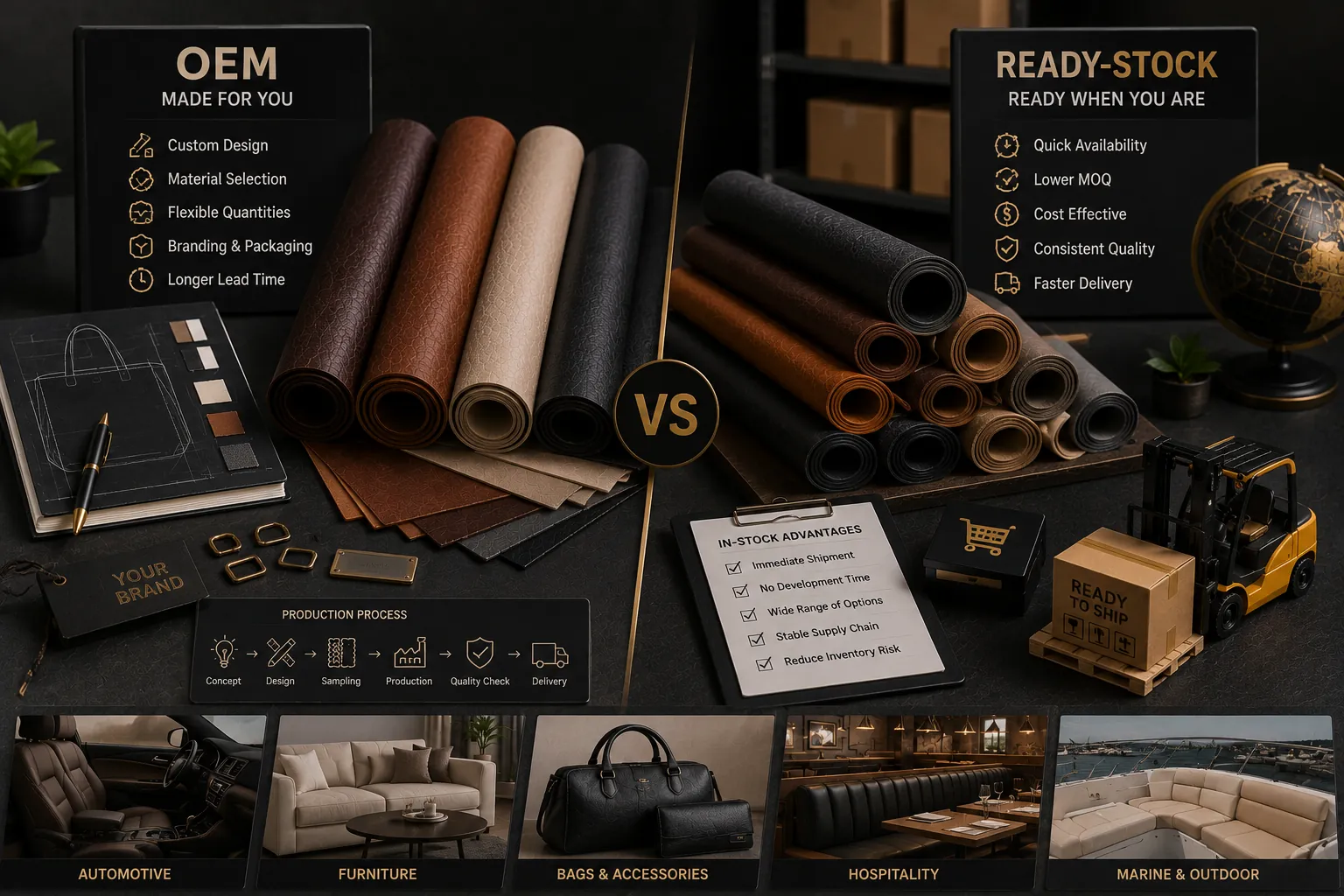
A furniture brand launching a new sofa collection in six weeks cannot wait for a custom OEM color formulation with a multi-week development cycle, so it sources from a supplier's ready-stock range instead. A private-label footwear brand building a differentiated product line, by contrast, needs an exclusive texture and color that competitors cannot simply reorder from the same catalog, making OEM the only viable path even at a longer lead time. Neither buyer made the wrong choice; they made the right choice for their specific constraint.
OEM and ready-stock are not a hierarchy where one model is inherently superior. They are two different procurement paths that trade speed and cost against exclusivity and customization, and the right choice depends entirely on what a buyer's product and timeline actually require. This comparison breaks down where each model wins.
Why Procurement Model Is a Strategic Decision, Not Just a Purchasing Choice
Choosing between OEM and ready-stock affects far more than a single purchase order; it shapes lead time, minimum order quantity, competitive differentiation, and how much control a buyer has over the final product specification. A brand that defaults to ready-stock without evaluating whether OEM would better serve a flagship product line may end up selling the same material as competitors sourcing from the same supplier catalog.
Conversely, a buyer who insists on OEM development for every order, including low-differentiation product lines, absorbs unnecessary lead time and MOQ costs where a ready-stock material would have performed identically for the end customer.
What Separates OEM from Ready-Stock Procurement
Ready-stock procurement means selecting from a supplier's existing catalog of colors, textures, and specifications, drawing from material that is already produced or can be produced quickly using established formulations. OEM procurement means specifying a custom color, texture, embossing pattern, or backing material that does not exist in the supplier's current range, requiring a development and approval process before full production begins.
The fundamental tradeoff runs through every downstream decision: ready-stock trades customization for speed and lower MOQ, while OEM trades speed and MOQ for exclusivity and precise specification control.
Head-to-Head: Cost, Lead Time, and Flexibility
| Factor | Ready-Stock | OEM |
| Minimum order quantity | Lower, draws from existing inventory | Higher, requires production setup |
| Lead time | Fastest, often ships from stock | Longer, includes development rounds |
| Cost per meter | Generally lower | Generally higher due to setup cost |
| Customization | Limited to existing catalog | Full control over color, texture, backing |
| Competitive exclusivity | Low, catalog is shared across buyers | High, formulation is buyer-specific |
| Best for | Time-sensitive or budget-driven orders | Flagship or private-label product lines |
When Ready-Stock Wins
Ready-stock is the stronger choice when a launch timeline cannot absorb a multi-week development cycle, when the product does not depend on a unique material identity to compete, or when a buyer is testing a new product category and wants to avoid committing to a custom formulation before validating demand. Standard residential furniture, general upholstery replacement, and early-stage product testing all favor ready-stock's speed and lower MOQ.
When OEM Wins
OEM wins when a brand needs a material that competitors cannot simply reorder from the same catalog, such as a flagship product line, a private-label retail program, or a technical specification that no existing stock color meets, such as a specific fire rating or an exact brand color match. Buyers with established, recurring volume are also better positioned to absorb OEM's higher MOQ and longer lead time, since the development cost amortizes across multiple future orders rather than a single run.
Which Model to Choose and When
Choose ready-stock when speed, lower MOQ, and budget matter more than exclusivity, and when an existing catalog color or texture already meets the product's functional requirements. Choose OEM when the product's competitive position depends on a material identity that cannot be replicated by a competitor sourcing from the same supplier, and when the timeline allows for a development and sampling cycle before production.
Speed or Exclusivity, Not Better or Worse
Neither OEM nor ready-stock is the universally correct procurement model; each wins under different constraints, and the strongest sourcing strategies use both depending on the product line. A brand might validate a new category with ready-stock material, then move its top-performing product to an OEM formulation once volume justifies the investment in exclusivity.
Buyers who evaluate this decision product by product, rather than defaulting to whichever model they used last, consistently get better outcomes on both cost and competitive differentiation.
Talk Through Your Procurement Options
Kodel Decorative offers both ready-stock collections and full OEM development from its Bangkok facility, so you can match the procurement model to each product line. Discuss MOQ, lead time, and OEM options directly: call 0 98 005 8863 or email kodeldecorative@gmail.com. Explore ready-stock options now at kodeldecorative.com/collection.