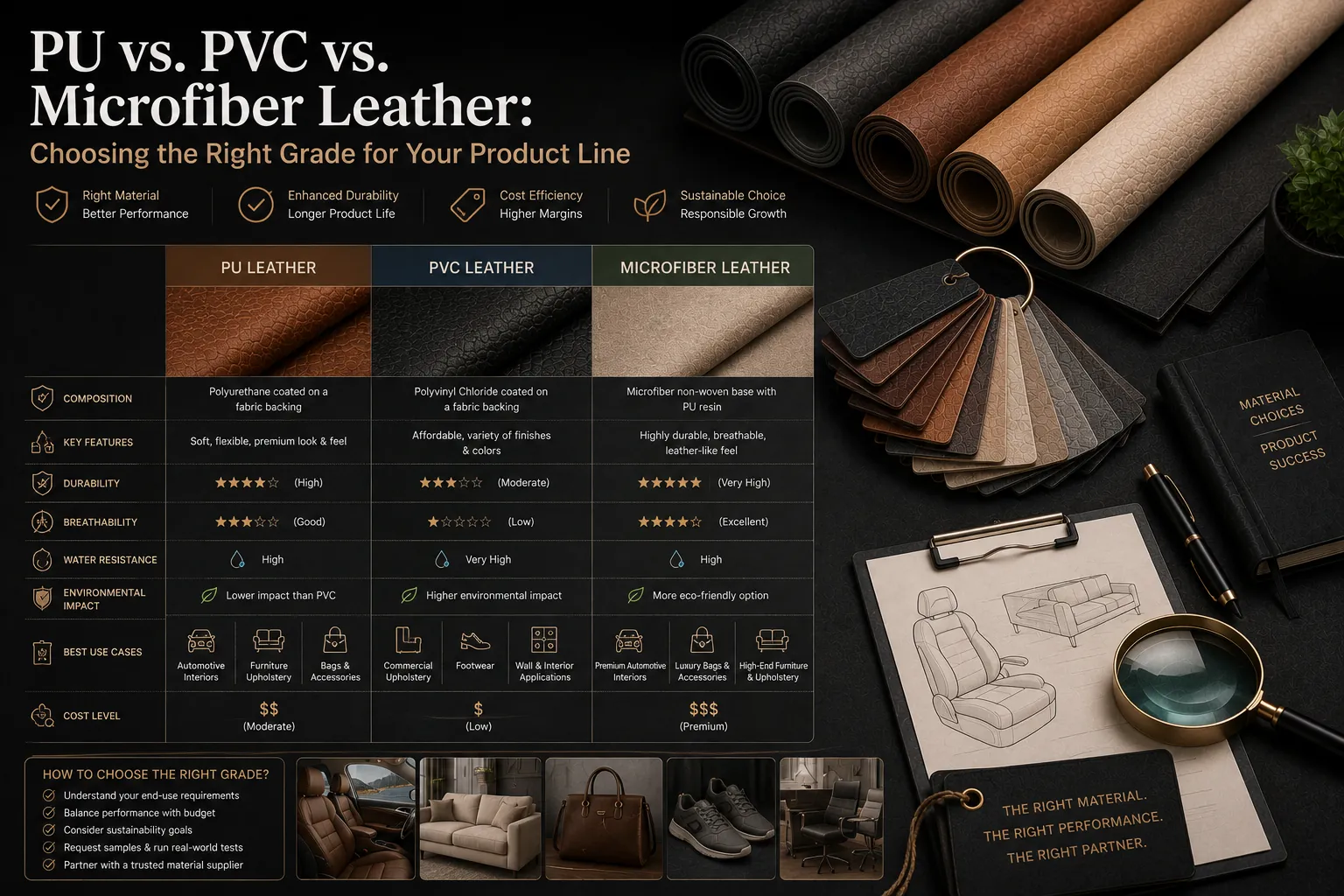
Product designers and sourcing managers often reach for 'synthetic leather' as a single category, but the three most common grades PU, PVC, and microfiber leather behave differently enough that the wrong choice shows up as returns, warranty claims, or a product that simply doesn't feel right in a customer's hands. This guide breaks down the practical differences and gives a framework for matching grade to application.
The Three Grades at a Glance
| PU Leather | PVC Leather | Microfiber Leather | |
|---|---|---|---|
| Structure | PU coating on woven/knit backing | PVC coating on fabric or non-woven backing | Ultra-fine polyester fibers, PU-impregnated |
| Feel | Soft, closest visual match to natural leather at accessible cost | Firmer, plastic-like hand feel | Closest to genuine leather in texture and breathability |
| Durability | Good; moderate abrasion resistance | Excellent abrasion and water resistance | Excellent; highest tear strength of the three |
| Best For | Furniture, bags, fashion accessories | Automotive, marine, gym/commercial seating | Premium upholstery, footwear, high-end bags |
| Relative Cost | $ | $ | $$$ |
PU Leather: The Versatile Default
For most furniture, bag, and fashion applications, PU leather remains the practical default. It offers a soft hand feel and a wide colour and texture range at a cost point that works for mid-to-high volume production. Where PU falls short is in heavy-abrasion, outdoor, or high-moisture environments, where it wears faster than PVC or microfiber alternatives.
PVC Leather: Built for Punishment
PVC leather trades some softness for durability. It's the standard choice for automotive seating, marine upholstery, gym equipment, and any commercial application where the material faces daily heavy use and needs to resist water and abrasion over years, not months. Thickness options typically range from around 0.6mm to 1.8mm, with heavier gauges used for the most demanding commercial environments.
Microfiber Leather: The Premium Middle Ground
Microfiber leather is built from ultra-fine polyester fibers impregnated with polyurethane, giving it a fiber structure that's genuinely closer to natural leather than either PU or PVC coatings. It offers the best combination of breathability, tear strength, and long-term durability of the three, which is why it commands a premium price and is typically reserved for higher-end upholstery, footwear, and luxury accessory lines where the extra cost is justified by product positioning.
Matching Grade to Application: A Quick Framework
- If cost and colour range are the priority, and the product sees moderate use → PU leather
- If the product will face water, heavy daily use, or outdoor exposure → PVC leather
- If the product is positioned as premium and breathability/hand feel matters most → microfiber leather
Custom and OEM Considerations
Once you've identified the right base grade, custom and OEM sourcing becomes about specification, not just material type: embossing pattern, backing fabric weight, finish (matte vs. gloss), and colour matching to brand specifications. Suppliers offering OEM synthetic leather manufacturing should be able to work from a physical reference sample or a Pantone reference and return a matched proof before committing to a full production run this step catches colour and texture mismatches before they become a bulk order problem.
Sourcing Note
Suppliers who stock all three grades in one catalogue — rather than specialising in just one make this comparison process considerably easier, since samples across PU, PVC, and microfiber can be evaluated side by side against the same application brief. Kodel Decorative maintains this kind of multi-grade catalogue from its Bangkok warehouse, with custom and OEM production available for buyers who've settled on a grade and are ready to move to a matched specification. For a full range of textures and grades, buyers can review a wholesale PU leather fabric or microfiber leather catalogue directly.
Final Word
There's no universally 'best' synthetic leather grade only the right grade for a specific application, cost target, and durability requirement. Working through structure, feel, durability, and cost systematically, rather than defaulting to whichever grade a single supplier happens to push, is what prevents an expensive re-spec after the first production run.